SyncSoft.AI
·
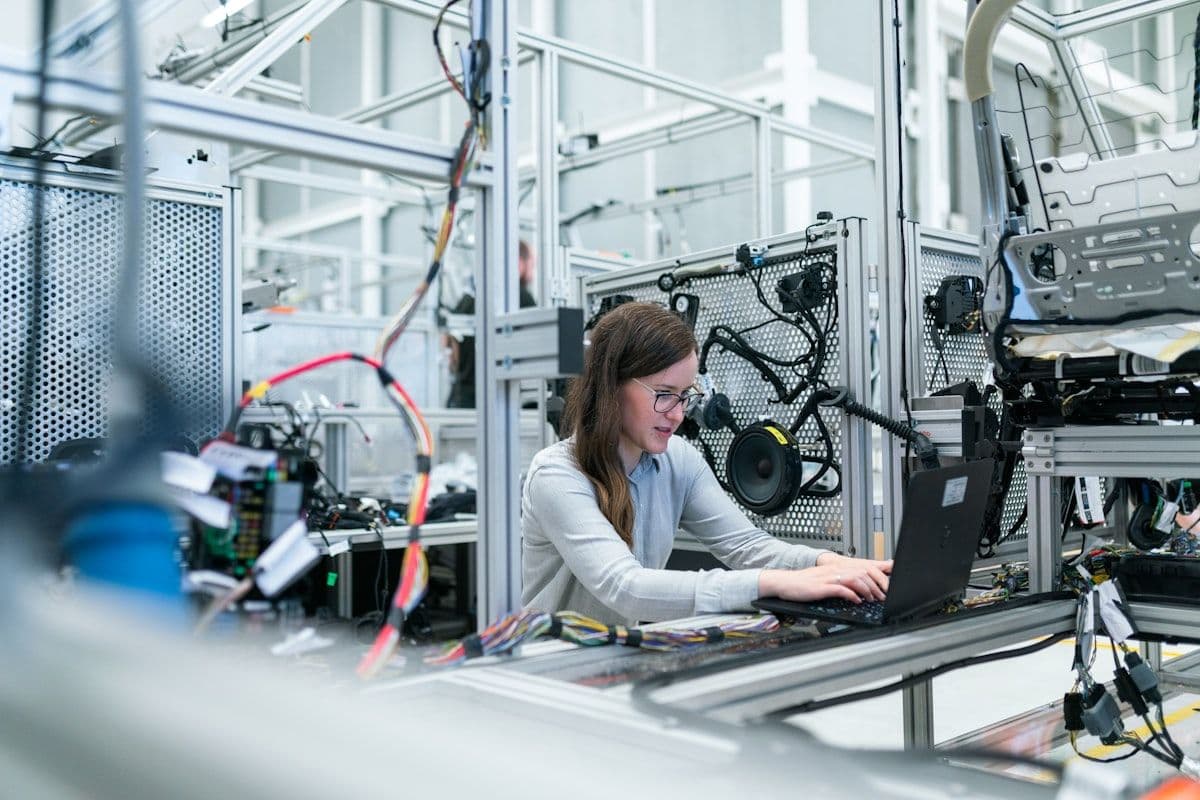
The robotics industry is experiencing unprecedented growth. The global market is projected to exceed $80 billion in 2026, driven by demand for warehouse automation, collaborative robots (cobots), and humanoid systems entering manufacturing floors worldwide. But here is the paradox that most industry reports overlook: the companies building these robots are drowning in operational overhead that has nothing to do with engineering.
From supply chain coordination and quality assurance documentation to customer onboarding and after-sales technical support, robotics companies — especially growth-stage startups — are discovering that scaling hardware operations requires a parallel investment in back-office infrastructure. And increasingly, the smartest move is to outsource it.
Building a robot is only half the battle. For every robotic arm that ships from a factory in Boston, Munich, or Shenzhen, there is a trail of operational processes that must execute flawlessly: procurement documentation, vendor management, regulatory compliance filings, warranty processing, installation scheduling, and post-deployment technical support. According to a 2026 McKinsey analysis, operational overhead accounts for 35-45% of total costs at robotics companies with fewer than 500 employees.
This is where Business Process Outsourcing enters the picture — not as a generic cost-cutting exercise, but as a strategic enabler that lets robotics companies focus engineering resources on what matters: building better robots. The BPO market itself has evolved dramatically, reaching $358 billion globally in 2026, with AI-augmented outsourcing becoming the dominant model.
Robotics manufacturing involves complex, multi-tier supply chains spanning dozens of countries. A single collaborative robot may source servo motors from Japan, sensors from Germany, aluminum extrusions from China, and control boards from Taiwan. Managing this supply chain — tracking shipments, coordinating with freight forwarders, handling customs documentation, reconciling invoices — is a full-time operation that scales linearly with production volume.
Outsourcing supply chain operations to specialized BPO teams allows robotics manufacturers to maintain real-time visibility across their supply network without building a 20-person procurement department internally. At SyncSoft AI, our data processing teams handle multi-format logistics data — from purchase orders and shipping manifests to IoT sensor logs from smart warehouses — processing terabytes of supply chain data through scalable pipelines that deliver actionable insights within hours, not days.
Every robot destined for a factory floor must meet rigorous safety and performance standards: ISO 10218 for industrial robots, ISO 15066 for collaborative robots, and increasingly, sector-specific certifications for food processing, pharmaceutical manufacturing, and surgical applications. The documentation burden is enormous. A single CE marking application for a new cobot model can generate 500+ pages of technical files, risk assessments, and test reports.
Outsourced QA documentation teams can manage this entire process — from maintaining test protocols and recording results to compiling regulatory submissions. SyncSoft AI's multi-layer QA process is particularly well-suited for this work. Our workflow mirrors the rigor that robotics companies need: every document passes through an initial preparer, a technical reviewer, a QA lead, and automated validation checks. We maintain 95%+ accuracy targets with Inter-Annotator Agreement tracking to ensure consistency across large documentation sets. For robotics clients, we apply domain-specific QA protocols that validate spatial accuracy in 3D technical diagrams and cross-reference test data against regulatory thresholds.
Customer support for robotics products is fundamentally different from supporting software or consumer electronics. When a warehouse robot goes offline, the customer is losing thousands of dollars per hour in productivity. When a surgical robot displays an error code, patient safety may be at stake. Robotics support requires technical depth, rapid escalation protocols, and 24/7 availability across time zones.
The 2026 trend toward Robotics-as-a-Service (RaaS) — where companies lease robots rather than buy them — makes this even more critical. RaaS providers need round-the-clock support infrastructure that would be prohibitively expensive to build in the US or Europe. By outsourcing Tier 1 and Tier 2 support to Vietnam-based teams, robotics companies can deliver enterprise-grade support at 40-60% lower cost than building equivalent teams in San Francisco or Berlin. SyncSoft AI's Vietnam-based operations offer exactly this advantage: high-quality technical support with significant cost savings, flexible pricing models (per-ticket, per-hour, or dedicated team), and the ability to ramp team size quickly during product launches or seasonal demand spikes.
Modern robots generate enormous volumes of operational data: LiDAR point clouds, camera feeds, IMU logs, force-torque sensor readings, and motor telemetry. This data is gold for product improvement and predictive maintenance — but only if it is properly collected, cleaned, and processed. A fleet of 100 warehouse AMRs can generate 2-3 terabytes of sensor data per day.
Outsourcing data processing pipelines to specialized teams makes this manageable. SyncSoft AI's data processing excellence extends to robotics-specific formats: we build collection pipelines that ingest LiDAR point clouds, stereo camera feeds, sensor fusion outputs, and IMU logs. Our preprocessing workflows handle multi-format data at scale — cleaning, normalizing, and structuring terabytes of robot sensor data efficiently so that engineering teams receive analysis-ready datasets rather than raw data dumps.
Robotics startups burning through Series A or Series B funding cannot afford to hire full back-office teams for HR administration, accounts payable, contract management, and investor reporting. Yet these functions are non-negotiable as companies scale from 20 to 200 employees. Outsourcing back-office administration lets founding teams focus 100% on product development and customer acquisition while maintaining the operational infrastructure that investors and customers expect.
The numbers speak for themselves. A fully-loaded back-office coordinator in the US costs $65,000-$85,000 annually. An equivalent role outsourced to a high-quality Vietnam-based provider like SyncSoft AI costs $18,000-$28,000 — a 40-60% reduction with no sacrifice in output quality. Our efficient workflows, proprietary tools, and streamlined processes further reduce turnaround times, meaning robotics startups get faster results at lower cost.
There is a growing intersection between traditional BPO services and the specialized data work that makes robots smarter. Robotics companies do not just need help with invoices and support tickets — they also need massive volumes of training data annotated for computer vision, navigation, and manipulation tasks.
This is where SyncSoft AI's data creation capabilities become a unique differentiator. We offer end-to-end annotation workflows covering 2D and 3D bounding boxes, semantic segmentation, instance segmentation, and polygon annotation. For robotics specifically, our teams specialize in point cloud annotation for LiDAR-equipped robots, depth map labeling for stereo vision systems, and sim-to-real data bridging that helps transfer models trained in simulation to physical robot environments. We also generate synthetic data to supplement real-world robot datasets — a critical capability when collecting physical robot data is expensive or dangerous.
Every annotation project runs through our domain-specific QA protocols for robotics data, including spatial accuracy validation for 3D annotations. Automated QC checks perform consistency scoring, outlier detection, and cross-validation, while continuous feedback loops between our QA team and annotators drive ongoing improvement. The result: robotics clients get training data that actually improves model performance, not just data that fills a labeling quota.
The International Federation of Robotics identified Physical AI as the defining robotics trend of 2026 — robots that use artificial intelligence to interact with the physical world autonomously. This trend is reshaping what robotics companies need from outsourcing partners. Traditional BPO was about handling paperwork. The new paradigm is about providing the operational backbone that enables Physical AI companies to scale.
Consider a company building autonomous mobile robots for warehouse logistics. They need supply chain management to source components globally. They need quality documentation for ISO certification. They need customer support for their RaaS platform. They need data pipelines to process fleet telemetry. And they need annotated training data to improve their navigation algorithms. A single outsourcing partner that can handle all of these functions — from back-office administration to specialized AI data services — eliminates coordination overhead and creates a unified operational layer.
This is the model SyncSoft AI is pioneering. By combining BPO operational support, data processing excellence, and AI data annotation capabilities under one roof, we give robotics companies a single partner for the entire operational stack — at Vietnam-competitive pricing that makes the unit economics work even for pre-revenue startups.
Not every BPO provider is equipped to support robotics companies. The technical complexity, regulatory requirements, and data sensitivity of the robotics industry demand specific capabilities. When evaluating potential outsourcing partners, robotics decision-makers should assess four critical dimensions.
First, data processing capability: can the provider handle multi-format technical data including CAD files, sensor logs, and compliance documents? Second, quality assurance rigor: does the provider maintain multi-layer QA processes with automated validation, or rely on single-pass review? Third, domain expertise: has the provider worked with hardware companies, manufacturing operations, or regulated industries? Fourth, cost structure: does the provider offer transparent pricing with flexible models that scale with your growth?
The robotics companies that get outsourcing right will scale faster, ship more reliable products, and maintain leaner operations than competitors trying to do everything in-house. In a market growing at double-digit rates, operational efficiency is not just a nice-to-have — it is a competitive weapon.
The $80 billion robotics market in 2026 is being built not just by brilliant engineers, but by the operational teams that keep the business machinery running behind the scenes. As humanoid robots enter factory floors, as RaaS transforms the business model, and as Physical AI demands unprecedented volumes of training data, robotics companies need outsourcing partners who understand both the business operations and the technical complexity of the industry.
The companies that recognize this early — that treat outsourcing as a strategic advantage rather than a cost center — will be the ones that dominate the next decade of the robot revolution. Whether you are a Series A startup shipping your first cobot or an established manufacturer scaling to global markets, the right BPO partner can be the difference between operational chaos and operational excellence.

With 1.3 million RaaS deployments projected by 2026, robotics-as-a-service providers face a $34 billion support infrastructure challenge. Here's how outsourcing Tier 1-3 technical support to Vietnam cuts costs 40-60% without sacrificing uptime SLAs.

A comprehensive analysis of the $358.58 billion BPO market in 2026, with data-driven breakdowns by region, industry sector, and growth projections through 2033.

Healthcare BPO is projected to reach $734.86 billion by 2030 at a 14.7% CAGR. Explore the forces driving this boom including medical coding transitions, RCM outsourcing, and AI-powered claims processing.
